





A Beginner’s Guide to Resistors, Capacitors, Diodes & More

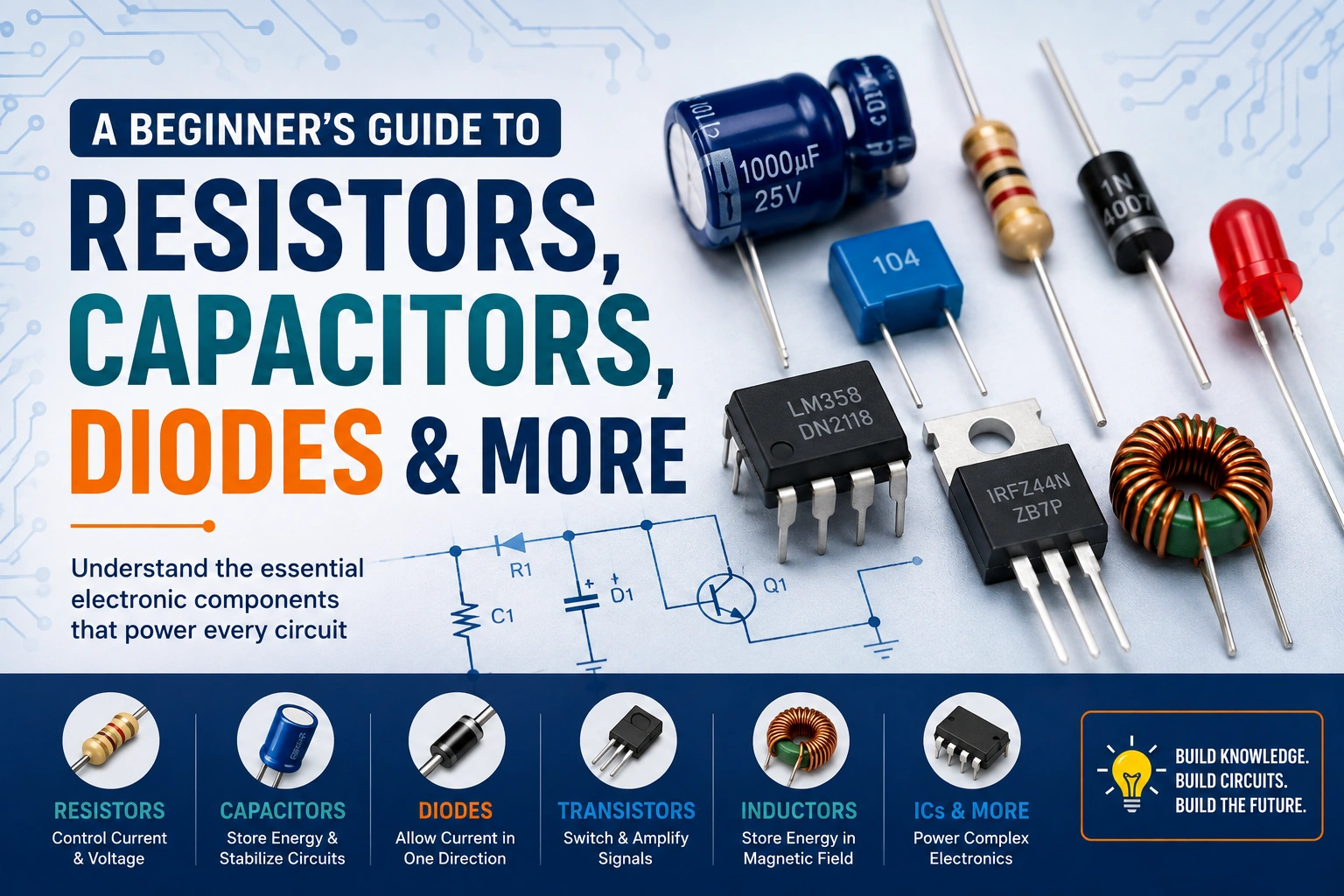
Electronic devices are built from a wide range of components, and understanding what each component does is the first step toward learning electronics. From simple circuits to complex computers, smartphones, IoT devices, and industrial systems, electronic components work together to control, store, convert, and process electrical energy.
If you’re new to electronics, some of the most important components to understand are resistors, capacitors, diodes, transistors, inductors, LEDs, and integrated circuits (ICs).
Let’s understand what they do and where they are commonly used.
What Are Electronic Components?
Electronic components are individual parts used to build an electronic circuit. Each component performs a specific function within the circuit.
For example:
- Resistors control electrical current.
- Capacitors store and release electrical energy.
- Diodes control the direction of current.
- Transistors can switch or amplify electrical signals.
- Inductors store energy in a magnetic field.
- LEDs convert electrical energy into light.
- ICs combine many electronic circuits into a small package.
By combining these components, engineers can create everything from simple LED circuits to sophisticated computers and embedded systems.
1. Resistors
A resistor is one of the most common components in electronics. Its primary purpose is to limit or control the flow of electrical current in a circuit.
Resistance is measured in ohms (Ω).
Resistors are commonly used for:
- Limiting current
- Dividing voltage
- Protecting components
- Setting signal levels
- Controlling transistor circuits
For example, when connecting an LED to a power source, a resistor is typically used to limit the current flowing through the LED and prevent damage.
The basic relationship between voltage, current, and resistance is described by Ohm’s Law:
Where:
- V = Voltage
- I = Current
- R = Resistance
2. Capacitors
A capacitor is a component that stores electrical energy temporarily and releases it when required.
Capacitance is measured in farads (F), although practical capacitors are commonly rated in microfarads (µF), nanofarads (nF), or picofarads (pF).
Capacitors are often used for:
- Power supply filtering
- Noise reduction
- Energy storage
- Signal coupling
- Timing circuits
- Voltage stabilization
For example, capacitors are frequently found near integrated circuits and power supply sections to help smooth voltage fluctuations.
Common Types of Capacitors
Some common capacitor types include:
- Ceramic capacitors
- Electrolytic capacitors
- Film capacitors
- Tantalum capacitors
Electrolytic capacitors are often used where relatively high capacitance is required, while ceramic capacitors are widely used for high-frequency filtering and decoupling.
3. Diodes
A diode is a semiconductor component that primarily allows current to flow in one direction.
This makes diodes useful for controlling current direction and protecting circuits.
Common applications include:
- Rectification
- Reverse-polarity protection
- Voltage regulation
- Signal processing
- Circuit protection
One common type is the rectifier diode, which is widely used in power supplies to convert AC into DC.
Another important type is the Zener diode, which can be used for voltage regulation and protection.
4. LEDs
An LED (Light-Emitting Diode) is a semiconductor device that produces light when current flows through it in the appropriate direction.
LEDs are commonly used in:
- Indicator lights
- Displays
- Automotive lighting
- General lighting
- Consumer electronics
- Signage
LEDs are available in different colors, sizes, brightness levels, and configurations.
Like other diodes, LEDs are polarity-sensitive and generally require appropriate current limiting when used in basic circuits.
5. Transistors
A transistor is a semiconductor device that can be used as an electronic switch or amplifier.
Transistors are fundamental to modern electronics and are found in virtually every type of electronic device.
They are used for:
- Switching circuits
- Signal amplification
- Motor control
- Power management
- Digital logic
Two major transistor families are:
- BJT (Bipolar Junction Transistor)
- MOSFET (Metal-Oxide-Semiconductor Field-Effect Transistor)
MOSFETs are particularly common in switching and power applications because they can efficiently control electrical power.
6. Inductors
An inductor is a passive component that stores energy in a magnetic field when current flows through it.
Inductance is measured in henries (H).
Inductors are commonly used in:
- Power supplies
- DC-DC converters
- Filters
- Radio-frequency circuits
- Energy storage
- Noise suppression
Inductors are particularly important in switching power supplies, where they help control and transfer energy efficiently.
7. Integrated Circuits (ICs)
An integrated circuit, commonly called an IC or chip, contains many electronic components integrated onto a small semiconductor die.
Instead of connecting hundreds or thousands of individual components separately, an IC can combine them into a compact package.
Examples include:
- Microcontrollers
- Microprocessors
- Memory chips
- Operational amplifiers
- Voltage regulators
- Communication ICs
- Sensor ICs
Modern smartphones, computers, vehicles, industrial machines, and IoT devices rely heavily on integrated circuits.
8. Switches
A switch is used to open or close an electrical circuit.
A simple switch can control whether current flows through a circuit.
Examples include:
- Push buttons
- Toggle switches
- Rotary switches
- DIP switches
- Tactile switches
Switches can also be implemented electronically using transistors and other semiconductor devices.
9. Sensors
Sensors detect changes in the physical environment and convert those changes into electrical signals that electronic systems can process.
Examples include:
- Temperature sensors
- Humidity sensors
- Light sensors
- Pressure sensors
- Motion sensors
- Proximity sensors
- Gas sensors
Sensors are especially important in IoT, robotics, automation, automotive electronics, and smart devices.
How Do These Components Work Together?
An electronic circuit rarely depends on just one component. Different components work together to perform a specific function.
For example, a simple LED circuit may contain:
Power Source → Resistor → LED → Ground
The resistor limits the current, while the LED converts electrical energy into light.
A more advanced system might include:
Sensor → Microcontroller → Transistor → Motor
Here, the sensor detects a condition, the microcontroller processes the information, and the transistor controls the motor.
This combination of components forms the foundation of many modern electronic systems.
Passive vs Active Components
Electronic components can broadly be divided into passive and active components.
Passive Components
Passive components generally do not provide power gain to a circuit.
Examples include:
- Resistors
- Capacitors
- Inductors
- Transformers
Active Components
Active components can control current or voltage and may provide amplification or switching functions.
Examples include:
- Transistors
- Diodes
- Integrated circuits
- Microcontrollers
The exact classification can vary depending on the context and convention, but this distinction is useful when learning basic electronics.
Quick Comparison of Common Components
| Component | Main Function | Common Applications |
|---|---|---|
| Resistor | Limits current | Current control, voltage division |
| Capacitor | Stores electrical energy | Filtering, timing, decoupling |
| Diode | Controls current direction | Rectification, protection |
| LED | Produces light | Indicators, displays, lighting |
| Transistor | Switches or amplifies | Switching, amplification |
| Inductor | Stores magnetic energy | Power supplies, filters |
| IC | Performs complex functions | Computing, control, communication |
| Sensor | Detects physical conditions | IoT, automation, robotics |
| Switch | Opens or closes a circuit | User controls, equipment |
Why Understanding Electronic Components Matters
Understanding individual components makes it much easier to understand complete electronic systems.
When you know what a resistor, capacitor, diode, transistor, and IC does, circuit diagrams become easier to read and troubleshooting becomes more straightforward.
This knowledge is useful for students, electronics enthusiasts, engineers, developers, and anyone working with embedded systems, IoT, robotics, automation, or hardware development.
Conclusion
Electronic components are the building blocks of modern technology. While components such as resistors, capacitors, and diodes may appear simple, they play essential roles in controlling and processing electrical signals and power.
As you progress into electronics, learning how these components behave individually—and how they work together in circuits—is an important foundation for designing and understanding more advanced systems.
Whether you’re building a simple LED project or developing a complex embedded product, understanding the basics of electronic components is where the journey begins.