





Semiconductors Explained: Types, Applications, and Why They Matter

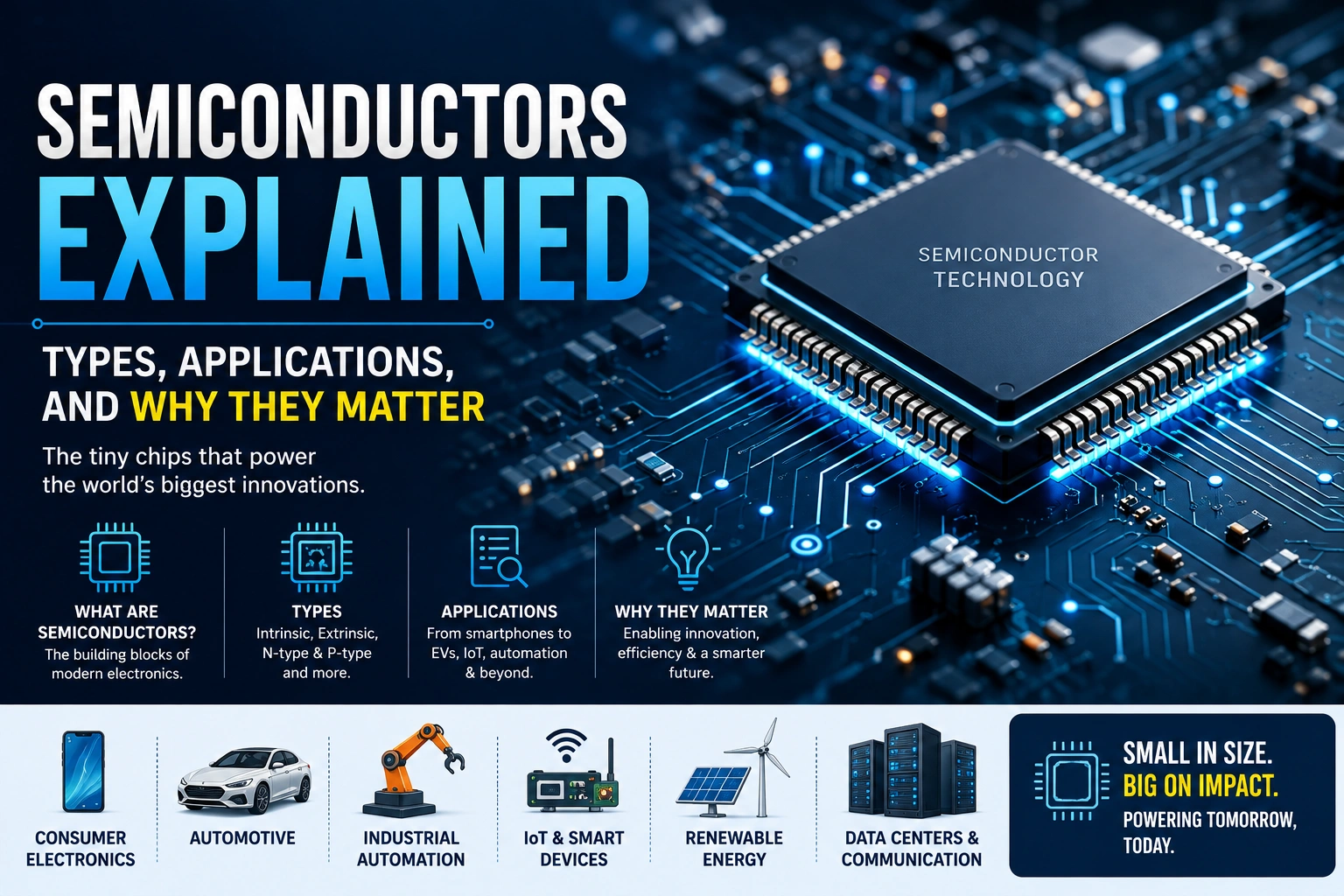
Semiconductors are the foundation of modern electronics. They are materials with electrical properties that fall between those of conductors, such as copper, and insulators, such as glass. Their ability to control the flow of electrical current makes them essential for everything from smartphones and computers to vehicles, industrial machines, and IoT devices.
What Is a Semiconductor?
A semiconductor is a material whose electrical conductivity can be controlled under different conditions. Silicon is the most widely used semiconductor material, although materials such as germanium and gallium nitride are also important in specific applications.
By carefully controlling their electrical properties, semiconductors can be used to create components such as:
- Diodes
- Transistors
- LEDs
- Integrated circuits (ICs)
- Microprocessors
- Memory chips
- Power devices
Types of Semiconductors
Semiconductors are generally divided into two basic types:
1. Intrinsic Semiconductors
An intrinsic semiconductor is a pure semiconductor material without intentionally added impurities. Its electrical conductivity primarily depends on the properties of the material itself.
2. Extrinsic Semiconductors
Extrinsic semiconductors are created by adding small amounts of specific impurities to a semiconductor material. This process, called doping, changes its electrical properties.
There are two main types:
- N-type semiconductor – has an increased concentration of electrons.
- P-type semiconductor – has an increased concentration of holes.
Combining P-type and N-type materials allows engineers to create semiconductor devices such as diodes and transistors.
Where Are Semiconductors Used?
Semiconductors are found in almost every modern electronic system.
Consumer Electronics
Smartphones, laptops, televisions, cameras, and gaming devices rely on semiconductor chips for processing, memory, communication, and power management.
Automotive
Modern vehicles use semiconductors for engine control, safety systems, infotainment, battery management, driver-assistance systems, and electric vehicle power systems.
Industrial Automation
Semiconductors help control motors, sensors, machines, power systems, and industrial communication equipment.
IoT and Smart Devices
Sensors, microcontrollers, wireless modules, and processors enable connected devices to collect, process, and transmit information.
Renewable Energy
Solar inverters, battery systems, electric vehicle chargers, and power converters use semiconductor power devices to efficiently control electrical energy.
Why Do Semiconductors Matter?
The importance of semiconductors comes from their ability to control electrical signals and power. A tiny semiconductor chip can contain millions or even billions of transistors, allowing complex computing and control functions to be performed in a very small space.
Semiconductor technology has made electronic devices:
- Smaller
- Faster
- More efficient
- More reliable
- More affordable
Conclusion
Semiconductors are the building blocks of modern technology. From a simple diode to advanced processors and power-management systems, semiconductor devices make it possible to control electricity and process information efficiently.
As technologies such as artificial intelligence, electric vehicles, robotics, 5G, renewable energy, and IoT continue to grow, semiconductors will remain at the heart of innovation and technological development.