





What Are Modules & Sensors?

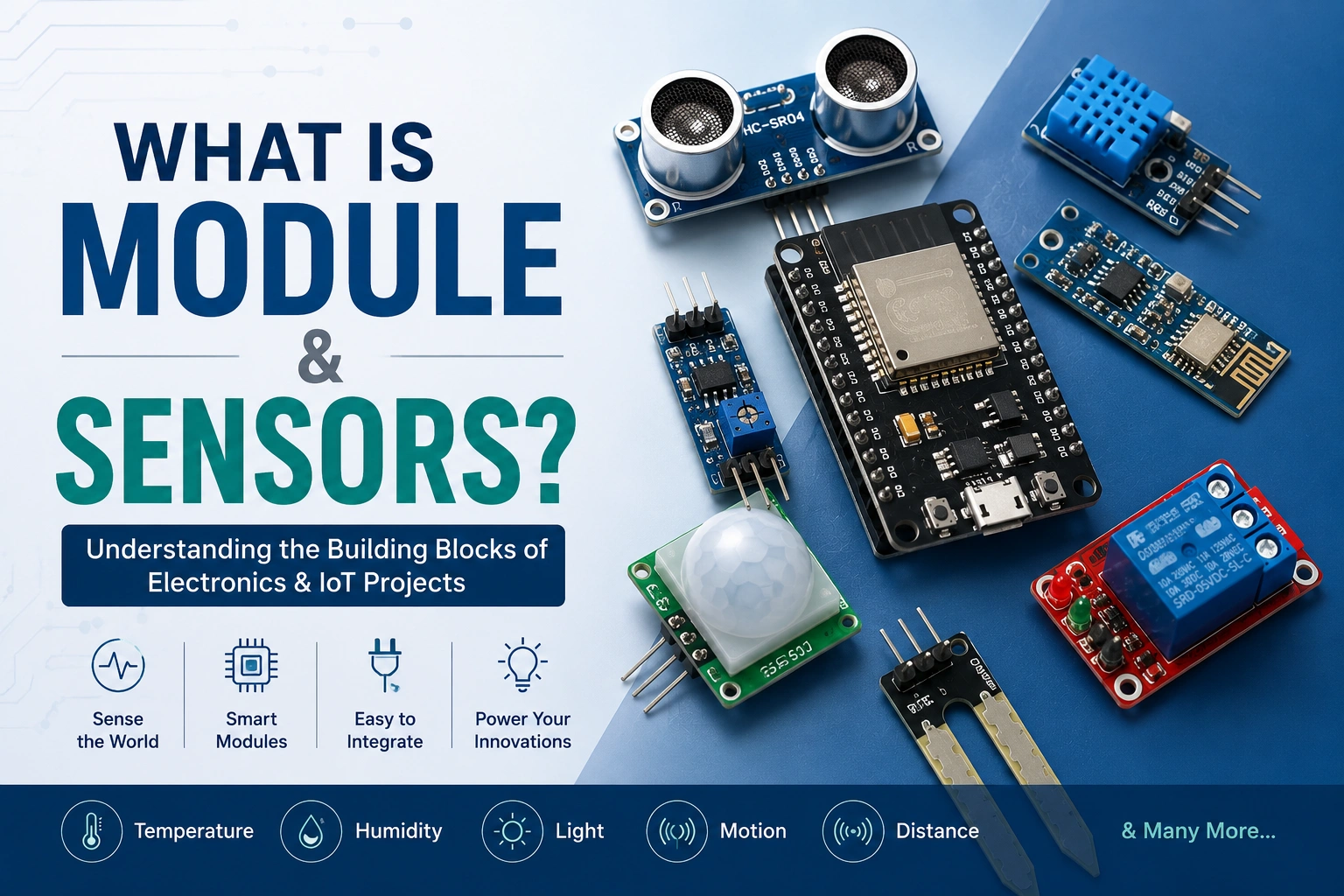
In electronics and embedded systems, modules and sensors are essential components that help devices interact with the physical world. They are commonly used in IoT, robotics, automation, smart devices, and industrial applications.
Although the terms are sometimes used together, a sensor and a module are not the same thing.
What Is a Sensor?
A sensor is an electronic component that detects a physical condition or change and converts it into an electrical signal that a system can understand.
Sensors can detect things such as:
- Temperature
- Humidity
- Light
- Motion
- Pressure
- Distance
- Gas
- Sound
- Acceleration
For example, a temperature sensor detects the surrounding temperature and provides a corresponding electrical signal to a microcontroller or development board.
What Is a Module?
An electronic module is a ready-to-use circuit that combines one or more electronic components to perform a specific function.
A module may contain a sensor along with supporting components such as resistors, capacitors, voltage regulators, communication circuits, or connectors. This makes it easier to connect the component to a development board without designing the supporting circuit from scratch.
Examples include:
- Wi-Fi modules
- Bluetooth modules
- Relay modules
- GPS modules
- Display modules
- Motor driver modules
- Sensor modules
Sensor vs Module
The simplest way to understand the difference is:
Sensor = detects something
Module = provides a ready-to-use function
For example, a temperature sensor may only provide the sensing element, while a temperature sensor module can include the sensor, supporting circuitry, and connection pins, making it easier to connect with an Arduino, ESP32, or other controller.
| Sensor | Module |
|---|---|
| Detects a physical condition | Performs a specific electronic function |
| May require additional circuitry | Usually includes supporting components |
| Can be a single component | Often contains multiple components |
| Requires more circuit design in some cases | Easier to integrate and prototype |
How Do Modules & Sensors Work Together?
In a typical IoT or automation project, a sensor collects information from the environment. The sensor or sensor module sends this information to a microcontroller or development board.
For example:
Temperature Sensor → ESP32 → Software → Display/Cloud
The sensor measures the temperature, the ESP32 processes the data, and the system can then display the reading or send it to a cloud platform.
Where Are They Used?
Modules and sensors are used in a wide range of applications, including:
- IoT devices – monitoring temperature, humidity, and environmental conditions
- Robotics – detecting obstacles, movement, and position
- Home automation – motion detection, smart lighting, and security
- Agriculture – soil moisture and environmental monitoring
- Industrial automation – machine monitoring and process control
- Healthcare devices – monitoring various physical parameters
- Smart vehicles – distance, motion, and environmental sensing
Conclusion
Sensors provide the ability to detect and measure, while modules make specific electronic functions easier to integrate and use. Together with development boards and software, they form the foundation of many modern embedded, IoT, robotics, and automation systems.
Understanding the difference between modules and sensors is an important first step when designing or prototyping an electronic project.