





Understanding Power Supply Components: A Beginner’s Guide

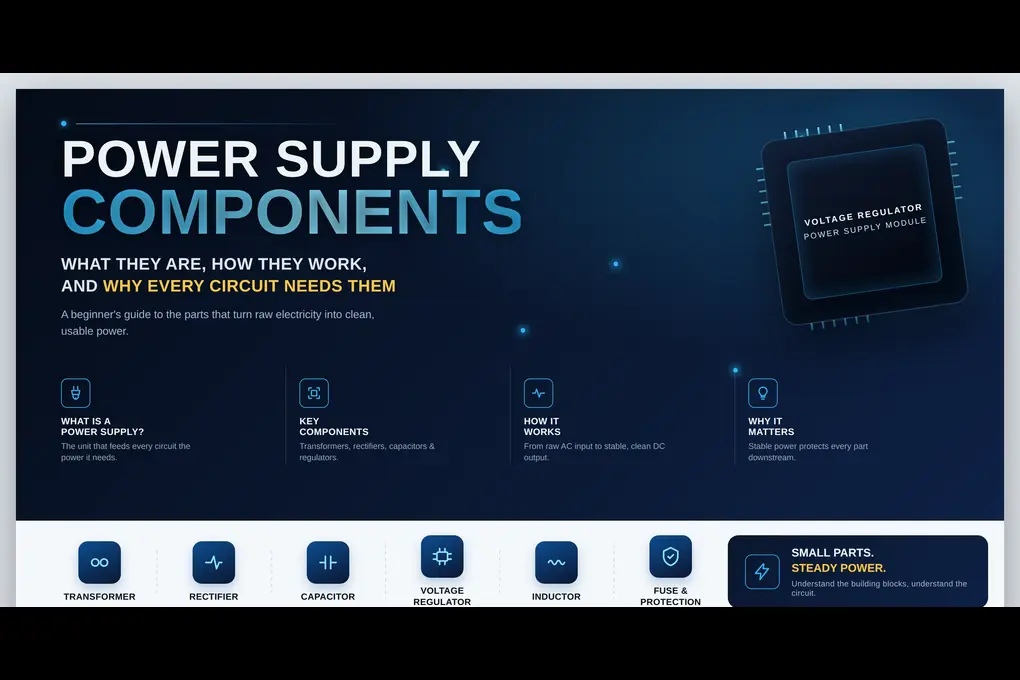
A power supply is one of the most important parts of any electronic system. Its job is to provide the correct voltage and current needed for electronic components to operate safely and reliably.
Whether you’re working on a small DIY circuit, an embedded system, industrial equipment, or a consumer electronic device, understanding the basic power supply components is essential.
What Is a Power Supply?
A power supply converts electrical energy from a source into a suitable form that an electronic circuit can use.
For example, a power supply may convert AC electricity from a wall outlet into stable DC voltage for an electronic device.
A typical AC-to-DC power supply can involve several stages:
AC Input → Transformer/Converter → Rectifier → Filter → Regulator → DC Output
Let’s look at the main components.
1. Transformer
A transformer is commonly used in traditional AC power supplies to increase or decrease AC voltage.
It can also provide electrical isolation between the input and output.
Transformers are particularly common in conventional linear power supplies, although many modern switching power supplies use different high-frequency transformer designs.
2. Rectifier
A rectifier converts AC voltage into pulsating DC voltage.
Diodes are commonly used to create rectifier circuits. A bridge rectifier, for example, typically uses four diodes to perform full-wave rectification.
The output still contains fluctuations, so additional filtering is required.
3. Capacitor
Capacitors are used to smooth the rectified voltage.
After rectification, the voltage isn’t perfectly stable. A capacitor charges when the voltage rises and releases stored energy as the voltage falls, helping reduce the variation known as ripple.
Larger electrolytic capacitors are commonly used for this purpose in power supply circuits.
4. Voltage Regulator
A voltage regulator helps maintain a stable output voltage even when the input voltage or load changes.
For example, a regulator can convert a fluctuating voltage into a more consistent 5V or 12V output.
Regulators can be:
- Linear regulators
- Switching regulators
- Buck converters
- Boost converters
- Buck-boost converters
5. Inductor
Inductors are particularly important in switching power supplies.
They store energy in a magnetic field and help control current as part of the switching and filtering process.
Inductors are commonly found in DC-DC converters and SMPS circuits.
6. Diodes
Diodes can perform several functions within a power supply, including:
- Rectification
- Reverse-polarity protection
- Freewheeling paths in switching circuits
- Voltage clamping
- Circuit protection
Different applications require different types of diodes.
7. Fuse and Protection Components
Power supplies also require protection against abnormal conditions.
A fuse can disconnect the circuit when excessive current flows. Other protection components may provide protection against:
- Overvoltage
- Overcurrent
- Short circuits
- Surges
- Reverse polarity
- Overheating
These features help protect both the power supply and the connected electronic equipment.
Linear vs Switching Power Supplies
Two common power supply approaches are linear and switching power supplies.
Linear power supplies are relatively simple and can provide low-noise output, but they can be less efficient and generate more heat.
Switching power supplies (SMPS) are generally more efficient and compact, making them widely used in computers, chargers, industrial equipment, TVs, and many other electronic devices.
Conclusion
A power supply is more than just a source of electricity. Components such as transformers, rectifiers, capacitors, inductors, regulators, diodes, and protection devices work together to deliver stable and reliable power.
Understanding these basic components gives beginners a strong foundation for learning circuit design, troubleshooting electronic systems, and building their own projects.