




What is a Development Board?

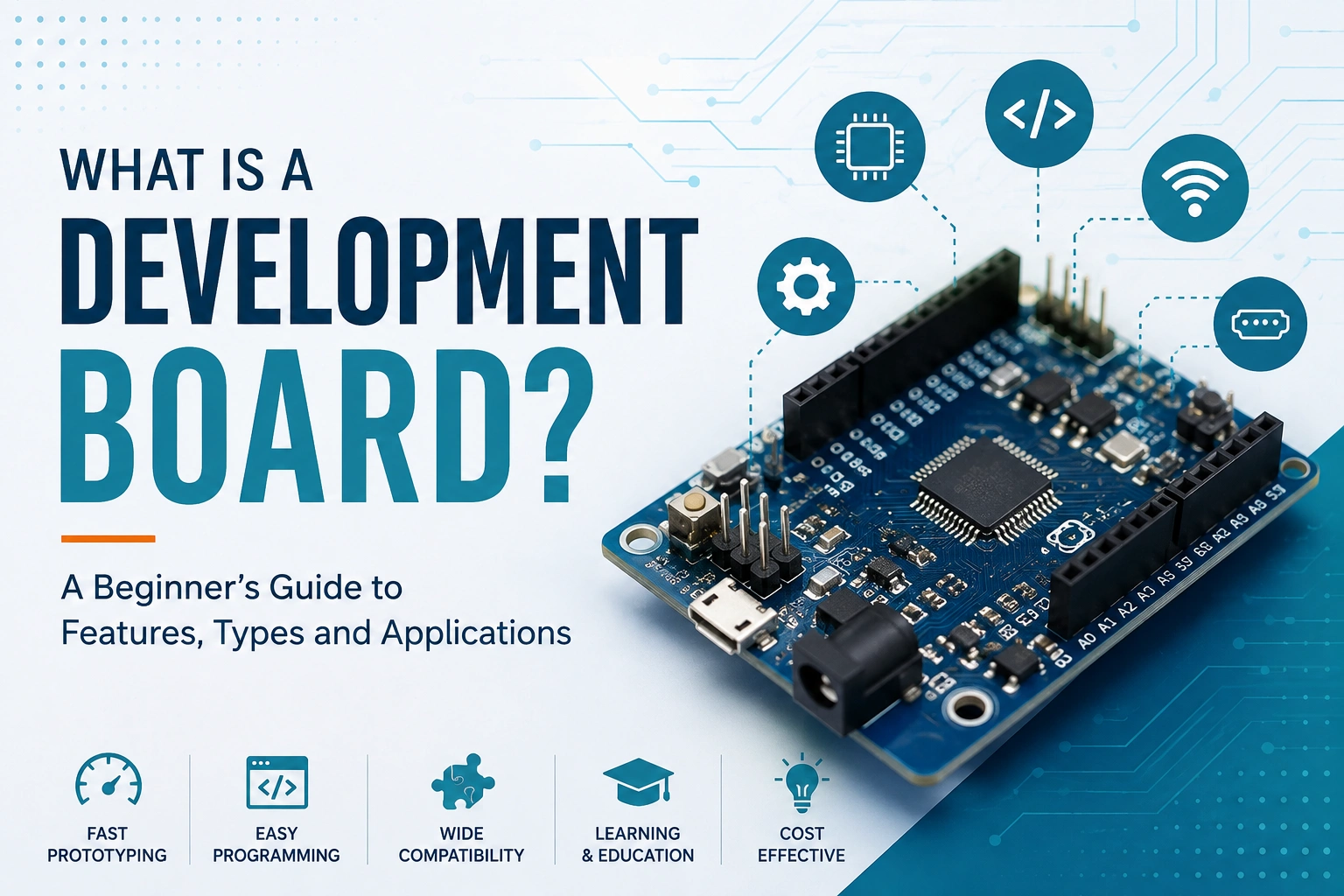
A development board is a ready-to-use electronic circuit board designed to help developers, engineers, students, and hobbyists build, test, and experiment with electronic projects quickly and easily. Instead of designing every component and connection from scratch, a development board provides a microcontroller, processor, input/output pins, communication interfaces, and other essential components on a single board.
Development boards are widely used in embedded systems, robotics, IoT, automation, consumer electronics, industrial applications, and educational projects.
How Does a Development Board Work?
A development board typically contains a central processing unit such as a microcontroller or microprocessor. This component runs the program or firmware that controls the connected hardware.
The board provides accessible pins and interfaces through which you can connect sensors, LEDs, motors, displays, buttons, communication modules, and other electronic components.
A typical development board may include:
- Microcontroller or microprocessor
- Digital and analog input/output pins
- USB interface
- Power supply and voltage regulation
- Communication interfaces such as UART, SPI, and I2C
- Programming or debugging interface
- Reset button
- Status LEDs
- Expansion connectors
Once the required hardware is connected, developers can write and upload code to the board using a computer.
Why Are Development Boards Used?
Designing a complete electronic circuit from the ground up can take significant time and requires knowledge of hardware design, power management, PCB layout, and component selection.
Development boards simplify this process by providing a working hardware platform that can be programmed and tested immediately.
Some of their key benefits include:
1. Faster Prototyping
Development boards allow developers to quickly create a working prototype without designing a custom PCB first.
2. Easy Programming
Most development boards can be programmed through USB or dedicated programming interfaces. Many also have software libraries and development environments that make programming easier.
3. Easy Hardware Integration
Built-in GPIO pins and communication interfaces make it simple to connect external sensors, displays, motors, and other devices.
4. Cost-Effective Development
For testing and proof-of-concept projects, using a development board can be considerably cheaper than manufacturing a custom PCB.
5. Learning and Education
Development boards are popular in schools, colleges, electronics courses, and maker communities because they provide an accessible way to learn programming and electronics.
Types of Development Boards
There are many types of development boards, each designed for different applications.
Microcontroller Development Boards
These boards are based on microcontrollers and are commonly used for controlling sensors, motors, LEDs, and other hardware.
Examples include:
- Arduino boards
- ESP32 development boards
- STM32 development boards
- Raspberry Pi Pico
They are commonly used in embedded systems, automation, robotics, and IoT projects.
Single-Board Computers
Single-board computers provide significantly more computing capability than traditional microcontroller boards. They can often run complete operating systems such as Linux.
Examples include:
- Raspberry Pi
- BeagleBone
- NVIDIA Jetson boards
These boards are useful for applications involving computer vision, artificial intelligence, networking, multimedia, and advanced computing.
IoT Development Boards
IoT-focused boards generally include wireless connectivity such as Wi-Fi, Bluetooth, Zigbee, or cellular communication.
For example, an ESP32 development board combines a microcontroller with Wi-Fi and Bluetooth, making it suitable for connected devices and smart-home applications.
FPGA Development Boards
FPGA boards contain programmable logic that can be configured for specialized hardware applications.
They are commonly used for:
- Digital signal processing
- Hardware acceleration
- Communication systems
- Industrial control
- Computer architecture research
Development Board vs. Custom PCB
A development board is primarily intended for development, testing, and prototyping, while a custom PCB is designed for a specific final product.
| Development Board | Custom PCB |
|---|---|
| Ready to use | Designed from scratch |
| Excellent for prototyping | Suitable for final products |
| Easy to program and test | Requires detailed hardware design |
| Usually larger | Can be highly compact |
| Flexible for experimentation | Optimized for a specific application |
| Faster development | Better control over cost and hardware |
A common development process is to first build and test a prototype using a development board. Once the design has been validated, the required circuitry can be integrated into a custom PCB for the final product.
Common Applications of Development Boards
Development boards are used across many industries and projects, including:
Robotics
They can control motors, sensors, robotic arms, autonomous vehicles, and other robotic systems.
Internet of Things
Development boards can collect sensor data and send it to cloud platforms or other connected devices.
Home Automation
They can be used to control lights, appliances, security systems, temperature sensors, and smart-home devices.
Industrial Automation
Engineers use development boards to test monitoring, control, sensing, and communication systems before implementing production hardware.
Artificial Intelligence
More powerful boards, such as NVIDIA Jetson platforms, can be used for machine learning, computer vision, and edge-AI applications.
Education and Research
Students and researchers use development boards to experiment with electronics, embedded programming, communication protocols, robotics, and automation.
How to Choose the Right Development Board
Choosing a development board depends on the requirements of your project. Consider the following factors:
Processor: Determine how much processing power your application needs.
Memory: Check the available RAM and storage for your program and data.
Connectivity: Consider whether you need Wi-Fi, Bluetooth, Ethernet, USB, CAN, or other communication interfaces.
GPIO and peripherals: Make sure the board has enough input/output pins and supports the peripherals you need.
Power requirements: Check the board’s operating voltage and power consumption.
Programming environment: Choose a platform with suitable programming languages, IDEs, libraries, and community support.
Expansion options: If you plan to add sensors or modules, check whether compatible expansion boards and accessories are available.
Cost: Consider both the development board price and the cost of additional components required for your project.
Development Boards in Product Development
Development boards play an important role in turning an idea into a working product. They allow developers to validate hardware concepts, test software, identify problems, and demonstrate prototypes before investing in custom hardware.
For example, a team developing a smart agriculture system might use an ESP32 development board to connect soil-moisture sensors, temperature sensors, and a wireless network. Once the prototype works reliably, the team can design a custom PCB containing only the components required for the final product.
This approach reduces development time and helps identify technical challenges early.
Conclusion
A development board is essentially a practical starting point for building and testing electronic systems. By combining a processor, power management, programming interface, and accessible input/output connections on one board, it makes hardware development faster, easier, and more accessible.
Whether you’re a student learning electronics, a hobbyist building a robotics project, an engineer developing an IoT device, or a company creating a new embedded product, the right development board can significantly simplify the prototyping process.